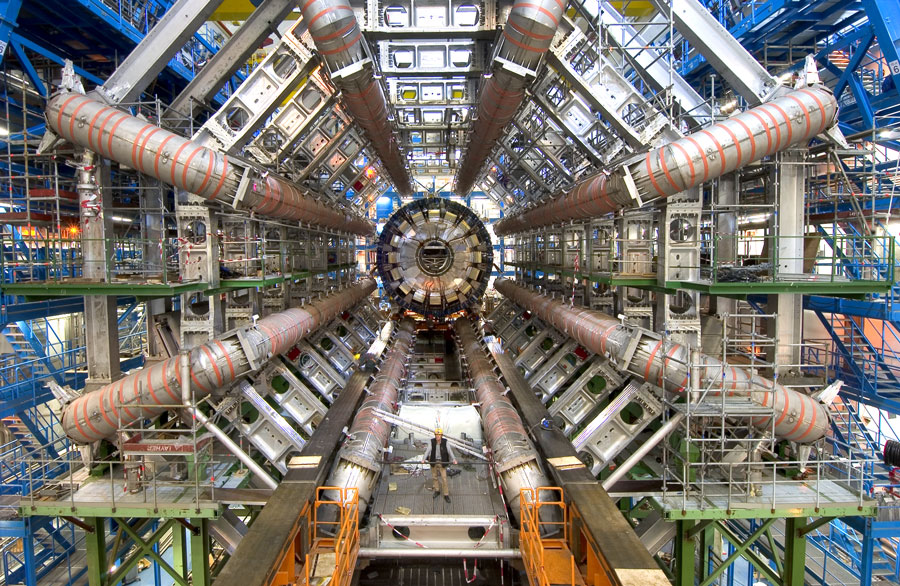
The Largest Machine Humans Built to Ask a Question
The Large Hadron Collider, or LHC, is a giant particle accelerator near Geneva. It is not a telescope and it is not a reactor. It is a machine designed to accelerate particles to enormous energies and smash them together so physicists can study what happens in the debris.
Why do that? Because at very high energies, nature reveals layers of structure that stay hidden in ordinary conditions.
How It Works in Plain Language
The LHC uses electric fields to accelerate charged particles and powerful magnets to bend them around a circular tunnel about 27 kilometres long. Beams race in opposite directions and collide at specific detector sites.
Those collisions do not look like tiny billiard balls cracking open. They look like showers of new particles and energy patterns that must be reconstructed by huge detectors and software.
| Part | Role | Why it matters |
|---|---|---|
| Accelerator ring | Speeds up particle beams | Creates extreme collision energies |
| Superconducting magnets | Bend and focus beams | Keep particles on track |
| Detectors | Record collision products | Turn invisible events into data |
| Computing systems | Filter and analyse results | Extract physics from enormous data streams |
What Did the LHC Discover?
Its most famous result is the discovery of the Higgs boson in 2012, confirming a major missing piece of the Standard Model. But that is not the whole story. The LHC also measures known particles with greater precision, tests theories beyond the Standard Model and explores exotic states of matter such as quark-gluon plasma.
Why Smash Particles Together?
Because high energy can be converted into mass and new particles. Particle collisions recreate conditions that are, in a limited sense, more like the early universe. The goal is not destruction for its own sake. It is controlled microscopic violence in service of knowledge.
Why Do Some People Fear It?
Big machines attract big myths. But the LHC explores energies that are tiny compared with many natural cosmic-ray collisions that strike Earth and other bodies all the time. The universe has already run higher-energy experiments naturally for billions of years.
What the LHC Really Represents
It is one of humanity’s boldest intellectual tools: an engineering monument built to ask what matter, forces and symmetry really are. That is why the LHC matters even to people who never plan to become physicists. It is curiosity at industrial scale.